Sunday, November 2, 2014

Goree Island and the Slave Trade

Goree is a small island 3km off of the Cape Vert Peninsula and now part of the city of Dakar. Goree was principally a trading post, trading beeswax, hides, grains, and most notably, slaves.


The shipping of slaves from Goree began in 1536 when the Portuguese launched the slave trade and the French continued it when they gained control in 1688 until it was halted in 1848.  On the island there is a small fort known as "Maison des esclaves" (Slave House).  This served as a slave warehouse through which Africans passed on their way to the Americas.


 During the Transatlantic slave trade millions passed through the island and other similar trading posts to work in the plantations of the New World, including those in the United States and the Caribbean.

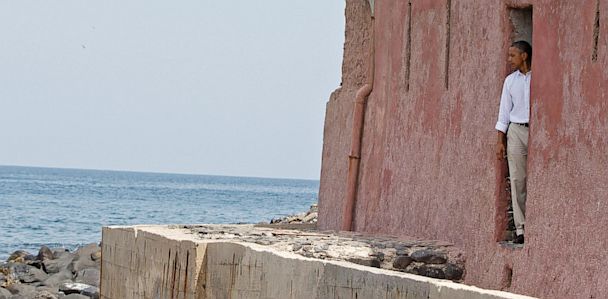
President Obama visits Goree in 2013.
The island's small size made it easy for merchants to control their captives.  The surrounding waters are so deep that many attempt at escaping would mean sure drowning, especially considering the fact that most captured Africans wore a 5 kg metal ball permanently attached to their feet or necks.


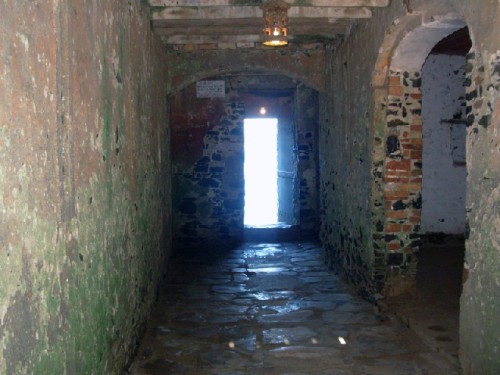
The Door of No Return
The island's remained continuously French until 1960, when Senegal was granted independence. In 1978, GorĂ©e Island was designated as a UNESCO World Heritage Site.  It is now a popular destination for tourists and school groups looking to learn more about the history of the slave trade in West Africa.

Above excerpts courtesy of:
the official!Peace!Corps!Senegal!website,!www.pcsenegal.org,!February!2009
http://en.wikipedia.org/wiki/Senegal#Ethnicity,!February!2009
http://news.bbc.co.uk/2/hi/africa/3054442.stm,!http://en.wikipedia.org/wiki/Goree_Island,!February!2009

Thursday, September 11, 2014

Conversational Pulaar

I've got less than a year left and I've realized I've never fully discussed my local language.  So here it is! The low down on Pulaar.

The language we speak down south is broadly know as "Pulaar" but can be broken into several different types, and in Senegal we have Fulakunda and Pullofuta.  They're only slightly different, and for the native speaker only slightly different; it's like an American speaking to a Brit or an Australian, slightly different yet they can mostly understand each other.

I learned Fulakunda during training, as the majority of Pulaars in Kolda are Fulakundas.  What a lovely surprise it was to find out that my immediate village would not be Fulakunda, but a mixture of Pullofutas, Bambarans, and Mandes.  The good news is that everyone speaks Pulaar, the bad news for 2013 Kim was that it was Pullofuta Pulaar.  It was a bit of an adjustment at first, but that's exactly what those first couple months were for, and once my village realized that I knew more Fulakunda words than Pullofuta words, they'd either switch to Fulakunda when speaking to me or yell the Pullofuta word at me until my brain remembered it.  Both techniques worked.

As I've mentioned in previous posts, greetings are especially important in all Senegalese cultures.  The first thing you do when you see a person is greet them, and exchange that can last for 2-100 back and forths.  Some Westerners find this annoying, but I find it wonderful.  What an easy way to make people happy!  And the best part is you can repeat the same greeting and even throw in some"Ca va?" and you're golden.

Here is a typical morning exchange with a neighbor:
Me: Walle-jam! (Good morning, or literally, sleep in peace)
Them: Jam toon! Tana finani? (Peace only! Good morning, or literally, you woke up?)
Me: Jam toon! Hono bimbi o? (Peace only! How's your morning?)
Them: Jam toon! Hono bandu ma? (Peace only! How's your body?)
Me: Jam toon! (Peace only)

Now this conversation can go a lot of different ways.  My favorite way it can go is just pointing out the obvious.  Senegalese people love to point out this obvious.  This is another cultural quirk that some people find annoying and I really love.  Again, less work for me during a conversation.  I can be doing anything, reading, pulling water, sitting, etc, and someone will inevitably ask.  "Oh, you're reading?" "Yes, I'm reading."  "Oh, you're eating?" "Yes, I'm eating."  "Oh, you're pulling water?"  "No, I carry full buckets of water around on my head for exercise." "Oh Aissatou, you're so funny!"

I know.

Islam in Senegal and Ramadan

In an overly simplistic summary, 95% of the Senegalese population became Muslim over hundreds of years of cultural exchange with the North Africans.  Over the years Islam developed from a religion of merchants, to a religion of the upper class, to the religion of the masses. Muslims resisted conversion to Christianity and even used Islam as a rallying point against colonization.

As mentioned before, the majority of Senegalese are Muslims, but that does not mean they are all the same type of Muslims.  Just as Christians are broken into Catholics and Lutherans, Episcopalians and Presbyterians, the Muslims of Senegal have options between sects, or brotherhoods.  These are distinct branches of Sufi Islam, which is based in mysticism and different from the Sunni and Shi'ite branches that are more prevalent in the Middle East.

One of the two largest of the brotherhoods are the Tidians (Ti-jaan).  This brotherhood was founded by an Algerian in the 18th century and is considered an Islam for the poor, as it was founded in rebuttal to more conservative brotherhoods.  It is now the largest Sufi brotherhood in West Africa, and in Senegal is especially popular among the Wolof ethnic group.  My village is also primarily Tidian, although it does not come up in conversation a lot. Today the Tidians put a great emphasis on Koranic learning and have even established schools for girls.

The other major brotherhood is the Mourides.  While the Tidians are popular throughout West Africa, the Mourides contain their following in Senegal and the Gambia.  Their religious city is Touba, where the founder of the Mourides was born; every year Mourides make a pilgrimage to Touba on their holy day.  They make up approximately 1/6 of Senegalese population.

The smallest brotherhood is the Qadiriyya.  It was brought in from North Africa by missionaries, and it is a more fundamentalist group that either the Tidians or the Mourides.

Islam is a central part to life in Senegal.  Each brotherhood has a leader, and you can see their faces hanging everywhere.  People love to show their support for their brotherhood.  They have tapestries they hang int heir houses, in their cars, buses can have decals on the windows.  These men wield a lot of power.  They can be politically influential if they so choose, and that means that political groups hoping to win will intentionally cater to brotherhood leaders.  The leaders can reach their followers mostly through the radio, but also television and newspapers.

What you all really want to know about though, is the holidays, am I right? I'm writing this in the middle between Senegal's two biggest holidays: Ramadan and Tabaski.  During Ramadan Muslims will fast from sunrise to sunset, and break the fast lavishly.  This means no food or water.  People will often wake up just before dawn to eat last nights leftovers in preparation for the day, and then depending on the time of year either go to the fields to work while they still have energy or go back to bed.  Work does not stop; women still have to do laundry, prepare a meal for the children if funds permit, and see to the compound.  Men still have to go to the fields and tend the animals.  If someone has a conventional job in the government, with NGO, or in a hospital, they still must go. 

To break the fast in my village we would drink instant coffee and powdered milk with a small chunk of bread.  Some families would also eat mogni (moe-knee), a millet based soup that tastes excellent with copious amounts of sugar.  People then take a break while the women cook dinner.  During Ramadan families try to have one lavish dinner each night, spending extra money on fish or meat and vegetables.  

Children, the sick, the elderly, and pregnant or nursing women are not obliged to fast as the others are, but they often still do, with negative effects on their health.  In my village the children would eat one mid morning meal of white rice with a bullion cube crushed up, and their parents would try to buy them snacks during the day.  Last year Ramadan was during mango season and those who weren't fasting snacked on mangoes all day.

Ramadan lasts for a month and then there's a big party! This party is called Tabaski.  Everyone will get all dressed up, cook an extravagant amount of food, and go see all of their friends and family.  This year my host family killed a goat and we had loads of meat!  I'll leave you with some pictures:

My host sister Ramatoulaye and host brother Yaya

The neighborhood kids doing some greetings

My host mom Oumou and me in our finest

My neighbor Sira posing for the camera


Some Political History

The country of Senegal did not have the modern borders until after 1963, when it reached independence.  Before the mid 1900's, the lands that would come to be known as Senegal went through several different waves of rule, and was often not actually under anyone's power.

French Colonial Possessions
The Mali Empire, which was based out of what is now Mali, held control for a time until European colonialists arrived in the mid 13th century. Over the years Portugal, Holland, Britain, and France all had colonial dealing in Senegal, but serious colonization by France didn't begin until the mid 1700's, when they reached farther into the interior searching for slaves, ivory, and Arabic gum, and they unsuccessfully encouraged the growth of cotton and cocoa.

Leopold Senghor
During the toil in Europe of the 18th century (revolutions, the Seven Years War, Napoleon, etc) all colonies of both Britain and France, including Senegal, became pawns in a larger game, and Senegal was lost for a while to the English, who had already retained control of what is now the Gambia.  In 1895 Senegal officially became a French colony.  France invited all of her colonies to join the French Union, offering citizenship to all those living in their colonies.

Around this time emerged and important figure: Leopold Senghor.  He initially ran the government on the interior of the country and eventually formed the Senegalese Democratic Bloc (or Socialist Party, SP), which we will hear more about soon.

Abdoulaye Wade
In 1958 France gave independence to their African colonies, with the West African colonies becoming the Mali Federation.. The western part of the federation withdrew in 1960, establishing two separate countries: Senegal in the west and Mali in the East.  Senghor became the president of Senegal and Mamadou Dia became the prime minister.  Dia staged an unsuccessful coup in 1962, ultimately leading to stronger presidential powers in the new constitution written in 1963.

Macky Sall
In 1981 Senegal and the Gambia attempted to join forces, each maintaining their political independence but consolidating their economies, defenses, and foreign relations.  It did not work and dissolved in 1989.

From independence until 2000, when Abdoulaye Wade won the presidential election in a run off, the SP ran Senegal.  In Jan., 2001, a new constitution was adopted, establishing a unicameral parliament and reducing the president's term to five years.  Despite Wade's strong start, some of his actions over his second term were seen as corrupt.  He tried to create a vice president in the government, presumably for his son, his second election was labeled as fraud by his opponents, and tried to run for a third term, despite precedent.  He ultimately lost in 2012 to Macky Sall, who achieved a landslide victory.  What is so amazing about this election is that Wade actually stepped down.  Generally Africa is no stranger to coups and politicians ignoring election results or just outright changing them; although Wade continues to be politically active and his son as political aspirations, he has made no overt attempts to take over Senegal.


SOURCES:
https://www.cia.gov/library/publications/the-world-factbook/geos/sg.html

Senegal: History | Infoplease.com http://www.infoplease.com/encyclopedia/world/senegal-country-africa-history.html#ixzz3D2fm6xZ2

Thursday, April 3, 2014

Sare Koutayel School Garden Project


     The garden was constructed and planted by early February.  Teachers, kids and community members alike are excited.  I can't tell you how many times a day I'm asked how my garden is and how the plants are doing.  "Jam tan," I tell them, "but it's YOUR garden!"

    My villagers also like tell me when things aren't going well!  Full disclosure, I've been insanely busy these past couple of months, and only made it out to the garden a couple of times a week to check and see that everything wasn't dead.  I'm also not a gardening expert, and while I've had some training and own a manual, there's a lot you can't learn from a book.  So my neene told me the lettuce didn't look good, and sure enough, the sun was burning it all; I talked to the teachers in charge, Monsieur Kande, and we're getting some shade.  Organization also needed to be readdressed- the kids are the ones taking care of the garden, but a lot of them don't know what they they don't always know what they're doing.

     To remedy this, I brought in Sustainable Agriculture PCV Brad Berry, to the the kids a better idea of how to take care of a garden.With the help of Monsieur Kande, we used a question and answer format to discuss how to properly water beds, mulch, space plants, and maintain plant nurseries.  For practice, we thinned the carrot nursery.  Next time, inshallah, we're going to transplant the onion nursery and learn how to properly prepare a bed with all of the amendments.

     I love this project because it covers several different areas.  Aside from the physical benefits (VEGETABLES) and giving the children a project of their own (instead of making them do all of the work and reap none of the benefits), several volunteers and I are going to be doing regular classes on nutrition, gardening, and trees.  I think it's really powerful when a bunch of adults give children this much attention, especially here.  School is a lot of memorization, and these activities can give kids a reason to get excited to love school!


Brad and me with our training group

A Peace Corps Volunteer's Job Description

So what exactly do I do over here in my tiny African village?  There are several different types of volunteers: agriculture, small enterprise, teaching, and health.  I am a health volunteer, so I work on health related activities in my community.

In Senegal health volunteers have three different sectors we work in: water and sanitation, malaria, and nutrition.  As secondary projects we can also work on health in pregnancy and youth and gender.

Water and Sanitation
In Senegal, especially in rural areas, there is little to no running water.  This mean no showers, no flushable toilets, and no sinks. Granted, cities tend to have these amenities more, but a village is lucky if they have a "robinet" or faucet.  In villages these are used primarily for drinking water, since they are harder to contaminate.  In my village we only have wells.  Women are responsible for pulling water for cooking, dishes, laundry, drinking, and every family members shower.  Some wells dry up seasonally, some are not safe to drink out of, and they can be far away from compounds.

Safe drinking water is a concern, as contaminated water can cause diarrhea.  Now, I know diarrhea is kind of a joke, but people, especially children, actually die from diarrhea every year.  (WHO says there were 1.7 billion cases of diarrhoeal cases last year, with 760,000 children under 5 dying in 2013 alone). These diseases can also be spread because people don't wash their hands, and those who do don't often use soap or another cleaning agent.  That means people don't wash their hands after going to the bathroom, dealing with animals, before cooking, before eating (most women eat with their hands), etc.

Volunteers help battle these problems, by building wells, well covers (to reduce contamination), and teaching people why we need to wash our hands and about the consequences of not having proper sanitation techniques.

Malaria
In 2012 there were approximately 207 billion cases of malaria, resulting in approximately 627,000 deaths.  The good news is that increased education, access to medicine, and promotion of insecticide treated bednets saved 3.3 million lives since 2000. (for more information see http://www.who.int/mediacentre/news/releases/2013/world-malaria-report-20131211/en/).

Malaria is a huge issue in Africa, and has seen a lot of attention from governments and NGOs alike, and what's really cool for me as a PC Senegal volunteer is that Senegal is on the forefront of a lot of the work being done.  In association with USAID, the Senegalese government is in the second phase of a universal bednet distribution, which aims to get every single person in Senegal to sleep under a bed net every night, all year.  This would ultimately slow the spread of the disease, which is mostly spread at night.

Volunteers participate in government funded events (remember the net distribution), but mostly do a lot of teaching and myth busting.  We spread what treatments are available at the health posts, how much they cost, as well as how the disease is spread and how they can stop the spread of disease.  April is International Malaria month, so look for some future posts about what we're doing here in Kolda!

Nutrition
Access to a healthy variety of foods can be a challenge in Senegal.  Students are not taught the food pyramid or other nutrition facts, and what they learn is mostly from home.  Sugary foods, even more than most places, are favored.

Volunteers help bring gardens to communities, teach nutrition facts and good practices, and teach mothers how to properly feed and wean infants to ensure a healthy growth pattern.


So that's a summary of what health volunteers in Senegal do! I'll be posting some of my projects as well, and any further questions can be sent to my email!

Jam tan,
Kim

Friday, February 28, 2014

Chebu Jen and Tentalu

So what, you ask, do we eat over here in Senegal?  That depends, firstly, on location, and secondly on family income.

    Cheebu Jen is the national dish of Senegal.  It consists of primarily rice with fish, but if the family has the money (or a garden) also includes vegetables.  They can add spices or a seasoning packet to the rice for an extra kick, but it can also be plain white rice.  They'll obviously gut the fish and de-scale it (that's the technical term).  The more vegetables in the bowl the more "patron" the family is, and in the culture the higher up you are on the social hierarchy the less of those good foods you get to eat.  It's a pretty ageist society, with elders getting the most of everything.    Eggplant, carrots, potatoes, hot peppers, bitter peppers, okra and and sometimes even cooked mangoes end up in this wonderful dish.  Cheb is a great dish, but with all the fish and veggies a good bowl of cheb can be pretty patron.  People in the cities tend to eat more cheb than people in the villages, and it's the typical party food for weddings and baptisms.
Meat Cheb at a Baptism
    This time of year there is a lot of mafe gerte, at least down south where I live.  This might be connected to the fact that my fathers are peanut farmers.  I love plain mafe gerte.  They grind of the peanuts and make it into a peanut sauce similar to peanut butter and then water it down.  If they're feeling adventurous they might add dried fish, tomato, or tentulu.  There are other types of mafe as well, the next most popular being leaf sauce.  It's ok and can be eaten with rice or cous cous.  We usually eat this for dinner.  Something I did not really grasp in my first couple months at site was that there are all different kinds of leaf sauce!  The best is moringa, which in the developing world is something of a miracle plant- it's got crazy, amazing amounts of vitamins and micronutrients, so obviously I push everyone to eat this.  Sometimes, though, it's not available, and we can also eat leaves from peanut plants, cassava plants, baobab trees, and bissap plants. Crushed hot pepper on the side makes it even better.

     What is this tentalu I speak of?  It translates into palm oil.  Here comes my first conundrum as a health volunteer.  I hate tentalu.  I've tried it several times and think it is absolutely disgusting.  Unfortunately, it's actually pretty good for you.  Generally, Senegalese people LOVE tentalu. My host mother was crushed when I told her I did not like it, but has since not made it when I have been home.

     Nancatangis a new favorite.  It's rice mixed with spices, peanuts and sometimes bits of dried fish.  It's good on it's own but again improved by crushed hot pepper.

My host mom cooking
     If there's some extra money or a special occasion cow, goat, sheep or chicken can be added to the dish.  I've eaten goat stomach, and once you get past the texture, it ain't too shabby.

    Those are pretty much lunch and dinner dishes, but we sometimes eat leftovers for breakfast (without meat).  There are also two types of porridges.  Gosi is a rice porridge often had with crushed peanuts, while mogni is cous cous porridge and one of my favorite things in Senegal.  You can add powdered milk or yogurt to add taste or texture.

     There are also bread stands all over the place, and here you can get a sandwich of sorts.  They will have beans, peas, mayonnaise, and sometimes eggs, which can be hard boiled or made into an omelette.  Eggs are semi-expensive though.  This can be complemented by a nice cup of cafe Touba or Nescafe, loaded with condensed milk and sugar.  It's delicious.

Beneits Before and After
Snacks are great too! We can get beneits (essentially fried dough), untu (fish balls), fruits, and glace (frozen juice- this is more impressive when you remember not many people have electricity).

   While eating out, which I tend to do in Kolda since I'm so lazy, there are several wonderful items you can eat.  There are chicken plates, and plates of beef, and spring roll-esque food called nems that I devour, but the unquestionably best and most delicious is the Senegalese variation of the hamburger.  American hamburgers generally have a bun, meat patty, lettuce, tomato, onions, ketchup with French Fries on the side.  In Senegal it's a little different.  Here there's also mayo (surprise!), an egg, and French fries inside the burger.  Take my work for it, it's delicious.

Jam tan.